
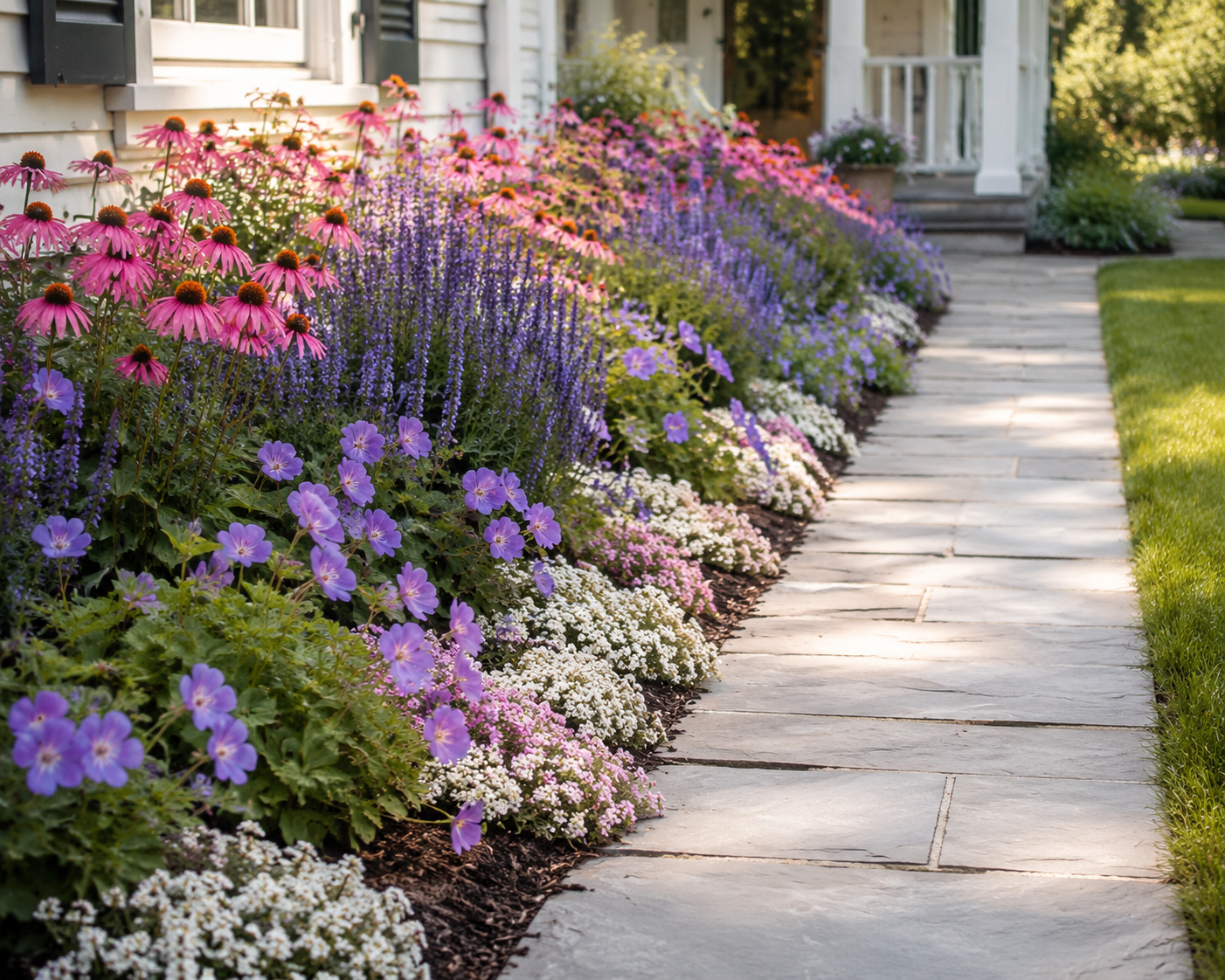
A walkway garden has a special kind of charm. You experience it slowly and at close range: the shape of a leaf, the movement of a flower spike and the way one color leads into the next.
But a successful path-side border needs more than pretty plants. It must fit the available light, respect the walking surface and still look intentional after every plant reaches its mature size.
Begin with the path, not the flowers
Measure the length and depth of the plantable area, then record the width of the existing walkway. That clear walking width is something to preserve—not space for future foliage to borrow.
Notice practical details before drawing the bed: doors that swing outward, gates, downspouts, hose routes, utility covers and places where people step off the path. A continuous flower border may look romantic on paper, but an intentional access gap is more useful than a plant that is repeatedly stepped on.
Design for the mature garden: space plants according to the width they will eventually reach, not the size of their nursery pots. University of Minnesota Extension similarly advises against overcrowding and recommends spacing plants for their mature size.
Check the light along the entire length
One end of a walkway can receive full afternoon sun while the other sits in shade from the house or porch. Observe the area several times during one clear day and identify whether it receives full sun, part sun or mostly shade.
Also check drainage. Roof runoff and hard surfaces can create unexpectedly wet pockets, while reflected heat can dry the soil beside masonry. Select plants for the conditions you actually have rather than relying on the overall impression of the yard. University of Minnesota Extension recommends assessing space, hardiness, light and soil conditions before choosing plants.
Build three gentle planting layers
Back layer
Use upright flowers or compact anchors to give the narrow bed height without excessive width.
Middle layer
Repeat mounded and vertical perennials to carry color and rhythm down the path.
Path edge
Choose low plants that soften the hard line while remaining easy to trim clear.
A three-foot-deep bed does not require three rigid rows. Stagger the plants and let the groups overlap visually, while still honoring their mature spacing. Taller bulbs can also rise behind low front-edge plants, a layering approach recommended by Illinois Extension.
Repeat plants to create movement
The prettiest walkway borders rarely depend on dozens of different plants. Choose a limited palette and repeat each variety several times. Repetition creates rhythm—the visual pattern that gives a garden order and flow—according to Penn State Extension’s garden-design guidance.
Try repeating one upright flower, one mounding perennial and one low edging plant. The recurring shapes lead the eye down the walkway and make the border feel more generous than a collection of single specimens.
Keep cottage color calm and connected
For a soft cottage look, begin with two or three related colors—perhaps pink, lavender, white and blue-violet—then let green foliage rest between them. Contrast can come from flower shape rather than a new color: daisy-like blooms, upright spires, airy sprays and low mats all contribute a different texture.
Stagger bloom times so the border changes through the seasons. Spring groundcovers, early-summer spires and summer-to-fall flowers keep the pathway interesting without requiring every plant to bloom at once.
Protect the walking surface
Leave a small setback between plant crowns and the edge of the path. Plants with arching or spreading habits may need extra room, even when their listed height is modest. Inspect the border during the growing season and lightly trim stems that begin narrowing the walk.
Good spacing is also healthier for plants. It improves airflow, makes weeding easier and reduces the constant pruning that results when a narrow border is planted too densely. University of Minnesota Extension advises spacing plants for their mature size to avoid crowding.
Let the pathway become part of the garden
The goal is not to hide the walk. The hard surface gives the flowers structure, while the planting makes the journey feel welcoming. When the plant groups repeat, the heights step down toward the edge and the walkway remains comfortably open, even a simple straight path can feel like an intentional cottage-garden feature.
Want a measured walkway garden?
My 3 × 12-foot Cottage Garden Walkway Plan includes an exact planting layout, 18-plant shopping list, substitutions, installation guidance and a finished-garden visualization for full-sun to part-sun spaces in USDA Zones 5–8.